
The Dark Side of Data Centers, Part 1: Energy Hogs
The recent rapid proliferation of artificial intelligence (AI) has driven explosive growth in a once-niche industry: data centers. These facilities host vast networks of computer processors that power the processing, storage, and management of the data underpinning our digital lives. While data centers themselves are not new, demand for them has surged as our reliance on cloud storage has increased and the AI computing race has accelerated. Yet even as data centers become essential infrastructure for an increasingly complex digital world, they also bring significant impacts that warrant close attention.
In Part 1 of the blog series, we will examine the energy usage of data centers. Part 2 focuses on water usage, while Part 3 examines the impact of data centers in Idaho specifically.
---------------------------------------------------------------------------------------------------------------------
Energy hogs
The computing activity (especially AI computing) involved with modern data centers demands an extraordinary amount of energy—often as much as an entire small city. In the last decade, data centers were typically in the range of 50 to 150 Megawatts (MW) capacity (i.e. the amount of energy they consume). These days, however, many new data centers average 300 MW capacity, with some “hyperscale” AI-intensive data centers that can draw an eye-popping 1 Gigawatt (GW) of electricity load. Every year, a 100 MW data center will consume 613,200 Megawatt hours (MWh) of electricity, which is enough to power roughly 56,000 homes. If you extrapolate that energy usage to a 1 GW hyperscale AI data center, such a facility would consume over 6 million MWh of electricity—enough to power all the households in Portland, Oregon for two straight years.
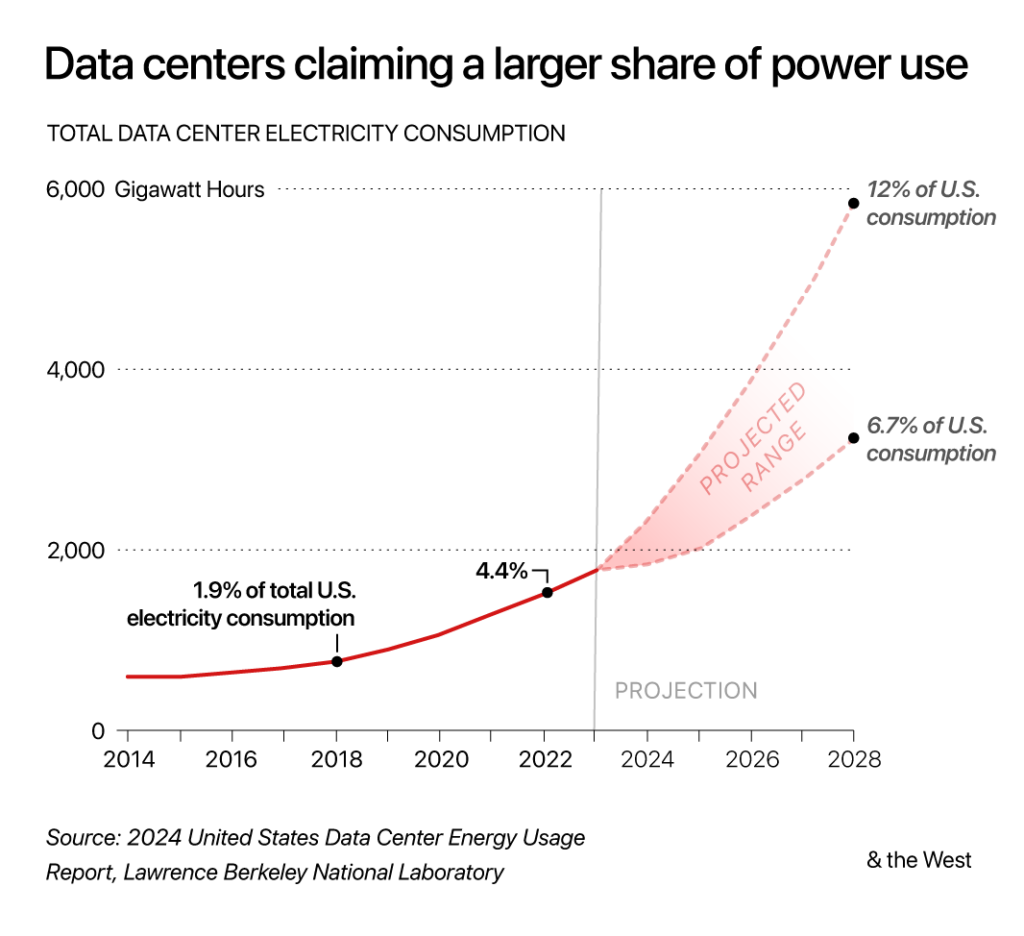
The energy demand due to data centers is unprecedented, both in terms of the demand for a single industrial “customer” and cumulatively for the power grid. Data center energy demand in the Pacific Northwest is projected to triple by 2029, and in some western states, data centers already account for over 10% of the state’s ENTIRE energy usage—a number that is certain to grow. For one major utility in Oregon, data centers are now responsible for a staggering 94% of their load growth in the last decade. As the below graph shows, the proliferation of data centers is expected to exponentially increase their share of power use across the U.S. in the years to come. Furthermore, data center companies and utilities have to worry not just about how much energy they need in order to operate, but how much new transmission infrastructure will be needed to deliver the necessary amount of energy.
Why does this matter?
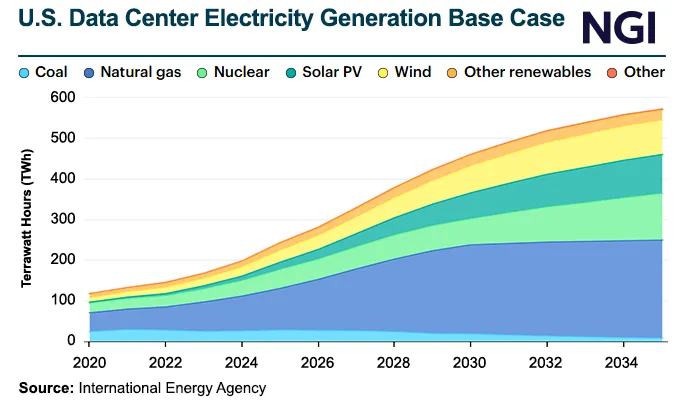
The enormous, unprecedented energy demand associated with data center growth will have profound implications for our energy grids, power bills, and ability to meet our climate goals. While solar and wind resources are rapidly coming online to the grid, it is not realistic that utilities and developers can meet the projected data center-driven energy demand with renewable energy alone. Thus, utilities are being pushed to hang on to dirty fossil fuel-based energy generation to prepare for this expected spike in demand. This translates to utilities keeping existing coal plants running well past their previously scheduled retirement dates as well as a renewed interest in building new natural gas plants. Even a data center that gets all of its power from solar and wind is still using energy resources that, without the extra demand, would otherwise be replacing dirty fossil fuels on the energy grid.
The data center energy boom also will have significant impacts on ratepayers—i.e. all of us that pay a power bill every month. In order to keep up with the skyrocketing energy demand associated with data centers, utilities around the country are building new infrastructure (e.g. power plants and transmission lines) to service that demand, with the costs of that new infrastructure often borne by each utility’s ratepayers. Furthermore, utilities often provide data centers with special (lower) rates due to the large amount of power they are buying (think of it as a bulk discount), essentially subsidized by other residential and commercial power customers. These two trends together create a likelihood that unregulated data center expansion, if it comes to fruition, will eventually raise electricity costs for families and businesses in many places.
Idaho Power, the largest power provider in the state, has said that the utility has extensive procedures in place approved by the Public Utilities Commission to ensure normal residential customers don’t subsidize large energy users or the infrastructure needed to specific service those large users (such as data centers). But given that there are no large operating data centers in Idaho yet, we will have to wait and see what impact data center growth in the state has on the average Idahoan’s power bill.
Looking ahead
The AI-fueled data center boom is here, and along with it, unprecedented increases in energy demand. As Jonathan Thompson writes in a recent High Country News article about data centers, “It’s one thing to see a lot of water or power used to grow food, for instance, but quite another to see coal power plants continue to run simply so that a computer can write a high school essay or answer an inane question or draw a picture or even serve as a companion of sorts.” Obviously, there are (and will be) more beneficial uses of AI, but the point is well taken. While the ultimate impacts of the data center boom remain to be seen, it is abundantly clear that it will reshape the energy grid as we know it today.
Learn more
“Thirsty for power and water, AI-crunching data centers sprout across the West” (& the West)
“The big data center buildup” (High Country News)
“The West’s data centers suck (water and power)” (High Country News)
“A.I. Is on the Rise, and So Is the Environmental Impact of the Data Centers That Drive It” (Smithsonian Magazine)
“Data Crunch: How the AI Boom Threatens to Entrench Fossil Fuels and Compromise Climate Goals” (Center for Biological Diversity)