
The Dark Side of Data Centers Part 2: Water Guzzlers
The recent rapid proliferation of artificial intelligence (AI) has driven explosive growth in a once-niche industry: data centers. These facilities host vast networks of computer processors that power the processing, storage, and management of the data underpinning our digital lives. While data centers themselves are not new, demand for them has surged as our reliance on cloud storage has increased and the AI computing race has accelerated. Yet even as data centers become essential infrastructure for an increasingly complex digital world, they also bring significant impacts that warrant close attention.
In Part 2 of the blog series, we will examine the water usage of data centers. Part 1 looked at the energy usage of data centers, while Part 3 examines the impact of data centers in Idaho specifically.
---------------------------------------------------------------------------------------------------------------------
Chill, Baby, Chill
Data centers, in addition to using a substantial amount of energy to operate, also require a significant amount of water - primarily for cooling purposes. The computing activity (especially AI computing) at data centers generates a lot of heat, with a water-based coolant system typically employed to dissipate that heat to acceptable levels in order to maintain the operational efficiency of the servers. Ultimately, the capacity of a data center is directly tied to how well it can cool its servers.
Exactly how data centers use water for cooling purposes depends in part on the climate of their physical location. In areas with low humidity, evaporative cooling - where warm data center air pulls heat from water as it evaporates, turning that liquid water into vapor and cooling the air around it - is often employed. In climates with higher humidity, refrigerated cooling - where refrigerant chemicals are used to chill water to then produce cool air - is the preferred option. Evaporative cooling is more water intensive but uses less energy, while the opposite is true for refrigerated cooling. Data centers located in cooler climates can also utilize ambient air cooling during the winter months, cutting down on water usage somewhat (but not entirely). Roughly 80% of the water used by data centers evaporates, with the remaining water discharged to municipal wastewater facilities (which may overwhelm the design capacity of those facilities).
Water Guzzlers
Every data center has different water requirements for cooling depending on the size of the facility, energy usage, and cooling methods used. Complicating matters further, in most states, data centers are not required to disclose their water usage. However, from what we do know, it is clear that data centers use a LOT of water, both on an individual and aggregate basis. At the high end, the biggest data centers can use up to 5 million gallons of water per day, totaling hundreds of millions or even billions of gallons of water annually. One such example is Google’s Council Bluffs data center in Iowa that uses an eye-popping 980 million gallons of water per year. Water usage from data centers of this scale is equivalent to the daily water usage of entire small cities.
Idaho’s only data center currently under construction (near Kuna) will use 70,000 gallons of water per day, or about 25 million gallons per year. Meta claims that this data center will use 80% less water than the industry average by using more efficient cooling technologies and by taking advantage of some ambient air cooling in the winter months (their actual water usage while operation remains to be seen, however). Zooming out, Google’s data centers globally used 8.65 billion gallons of water in 2023 per their own environmental reports - and Google of course is just one of many major tech companies with data centers.
Data centers can also have an impact on water quality. For example, a recent Rolling Stone investigative article showed that data centers in Eastern Oregon used local groundwater that was already high in nitrate (on average 13 parts per million). Once that water was run through the cooling system, some of the water evaporated as part of the cooling process but the nitrates remained. By the time the remaining water was discharged back to the wastewater treatment system, it averaged 56 ppm nitrate, over 4 times the original concentration and over 5 times the legal limit. So while the data centers were not the original cause of the nitrate pollution (that was from agriculture), they have demonstrably exacerbated the problem in that area. High nitrate in drinking water has been linked to cancer and increased risk of miscarriages.
Why does this matter?
Water is life - especially in the arid West. And while data center water usage is currently much less than some other sectors in our economy. such as irrigated agriculture and meat production, it is a big enough water source that we need to take it seriously. Some areas might have enough water to support the cooling needs of large data centers, while others (e.g. in the Desert Southwest) most likely do not. And it’s not just that data centers use a lot of water; as the graph below shows, much of the water being used is potable drinking water (despite that level of water quality not being necessary for cooling functionality).
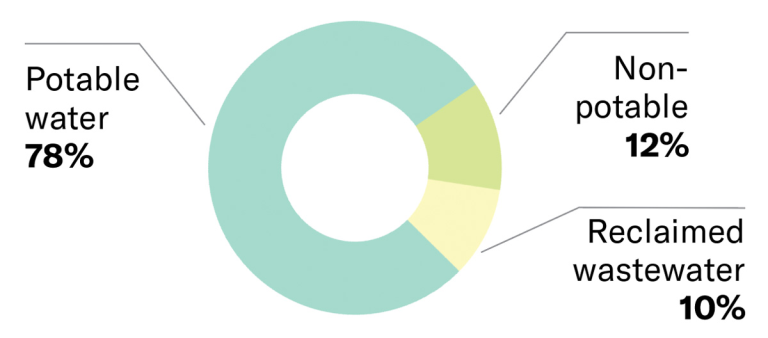
Graph of water usage by Google’s data centers in 2023 (https://www.apmresearchlab.org/10x/data-centers-resource)
Looking ahead
As water becomes more scarce across the West, the proliferation of water-hungry data centers will be another pressure point on this essential but dwindling resource. Data centers alone will not create a water crisis, but it certainly won’t help the current situation. Large tech companies will likely be looking for ways to use water more efficiently in their data centers in order to reduce the water rights they need and lessen public blowback over their water usage. Some companies are beginning to use reclaimed wastewater for cooling rather than potable water, which would help lessen their water-related impacts. The tech company Meta has gone even further than that by making a pledge to be “water positive” by 2030, which they define as “return[ing] more water than we consume in our operations through water restoration initiatives.”
From our perspective, it is crucial that data centers reduce their water impact to the extent possible and provide transparency about their operations, including how much water they expect to use, where they will get their water from, and how their wastewater will be treated.
Learn More
“Thirsty for power and water, AI-crunching data centers sprout across the West” (& the West)
“Are data centers depleting the Southwest’s water and energy resources?“ (APM Research Lab)
“What happens when a data center comes to town” (University of Michigan)
“How Oregon’s Data Center Boom is Supercharging a Water Crisis” (Rolling Stone)