
Survey shows community support for McCall land exchange
For the past 5 years, ICL has worked with United Payette, a coalition of Valley County residents partnering with local and state-wide organizations, to conserve the endowment lands surrounding Payette and Little Payette Lakes. In 2024, the Idaho Department of Lands (IDL) and the U.S. Forest Service (USFS) reinitiated discussions about the possibility of a land exchange that would move the ownership and management of portions of the state-owned endowment lands to the Forest Service. IDL would receive parcels of land from the Forest Service in return.
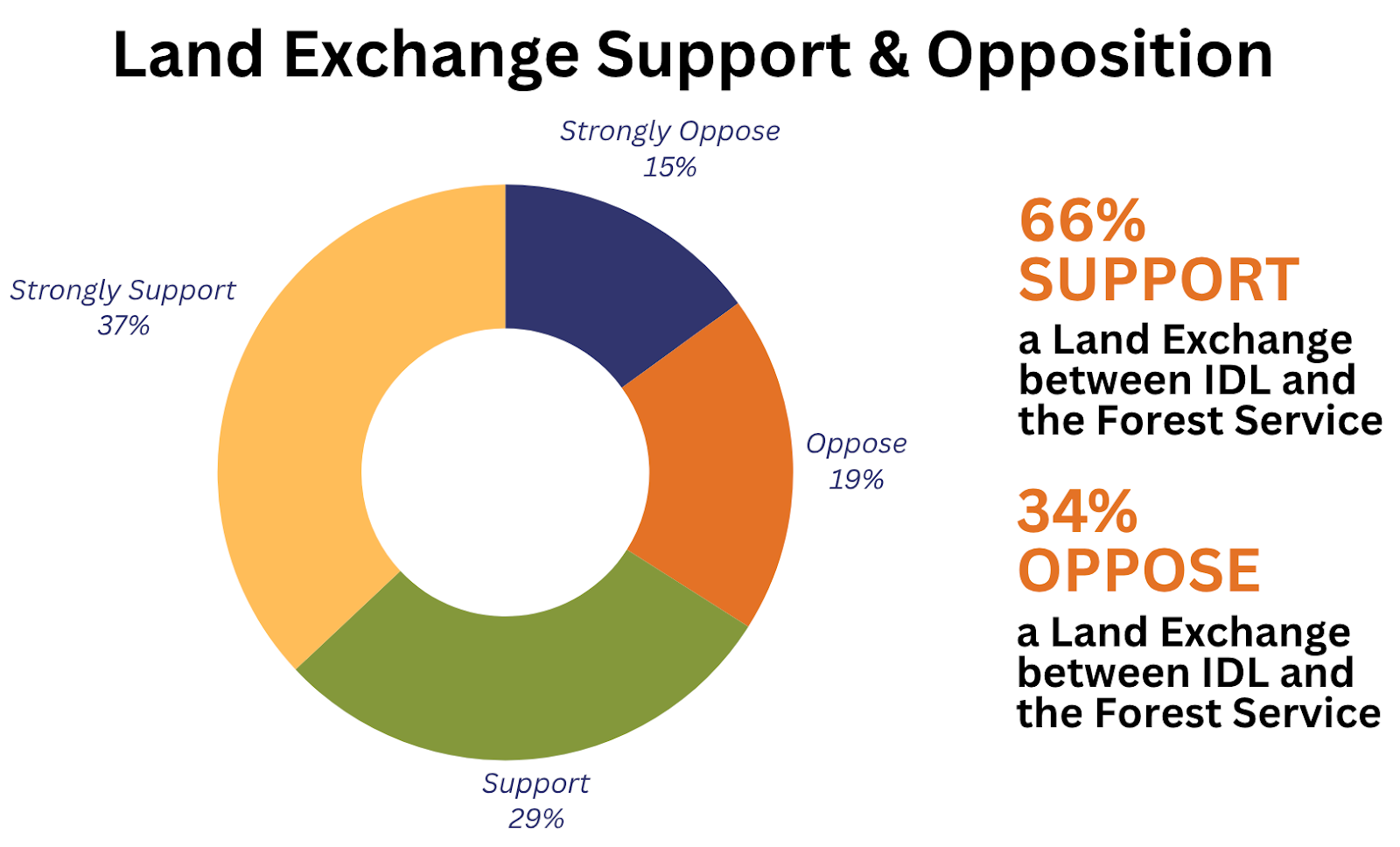
During the recently passed summer, United Payette contracted with the University of Idaho’s (U of I) College of Natural Resources to conduct a public opinion poll in Valley County. The U of I researchers implemented the survey from May 17 to July 31, 2025, with the primary goal of assessing Valley County residents’ opinions on the perceived benefits from, and threats to, the state-owned and managed lands surrounding Payette Lake and Little Payette Lake, and to determine if Valley County believes that a potential exchange is in the best public interest. The public survey shows that 66% of Valley County residents’ support a land exchange between the USFS and IDL.
Survey basics and results
Invitations to participate in the survey were sent to 6,738 addresses in Valley County. Based on recent census data, researchers determined that 372 complete responses were needed for a 5% margin of error with 95% confidence. This means that if we conducted the survey 100 times, we would get the same results 95 of those 100 times, plus or minus 5%. After data cleaning, we received 840 complete surveys, which lowered the margin of error to 3.3% with 95% confidence! These numbers assured United Payette that the results are truly representative of Valley County. Survey results highlights include:
66% of survey respondents support a potential land exchange to conserve the endowment lands surrounding Payette and Little Payette Lakes
85% of respondents indicate an exchange is very to extremely important
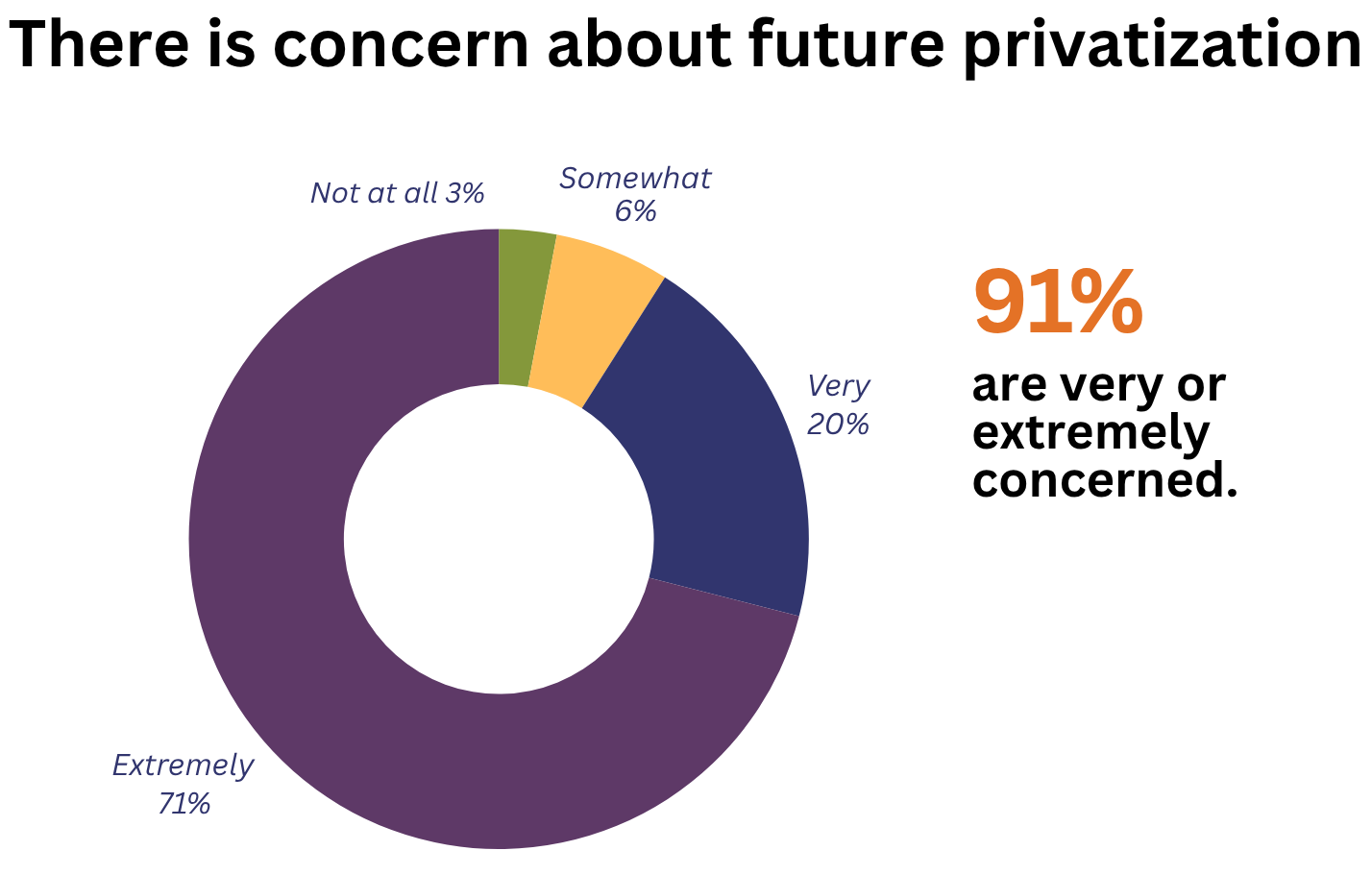
91% of survey respondents are very or extremely concerned about future privatization. These results support a recent Conservation Voters for Idaho poll that found that 96% of Idahoans across political boundaries believe public lands should remain in public hands
98% believe that protecting Payette Lake’s water quality is a top priority
93% of survey respondents identified decreased drinking water quality as a significant threat
The perceived threat to identified benefits provided by the endowment lands, such as water quality, wildlife and fish habitat, ecosystem and watershed health, public access, rural character and scenic value outweigh economic factors, such as increased tourism and recreation use, the loss of tourism industries, or increased winter recreation use
How did we get here?
In 2020, Trident Holdings, LLC, a private development company, proposed to acquire 20,000+ acres of state-owned endowment lands in McCall for similar acreage of northern Idaho timberlands. Trident proposed developing parcels that adjoined Payette Lake, as well as several additional high value parcels, for elite homes, golf courses, lodges, and commercial businesses typically associated with destination mountain towns such as Aspen and Sun Valley.
Despite Trident’s pledge to donate the remaining undeveloped acreage to Ponderosa State Park, there were a few problems with the proposal. First, Trident’s leaders failed to consult with Valley County residents and officials, who it turns out were adamantly opposed to the proposal and the idea of transforming McCall into the next Telluride or Lake Tahoe. Second, Trident didn’t actually own the north Idaho timberlands the company wanted to exchange for the McCall endowment lands. It is hard to make a trade for something when you don’t have the materials or goods to trade with!
Finally, IDL determined that even if Trident owned the northern Idaho timberlands the company proposed to trade for the McCall endowment lands, the appraised value of the McCall endowment lands was much higher than the northern Idaho timberlands. Therefore, Trident would need more land or cash in order to make the exchange relevant and enticing for IDL. In the end, IDL rejected the Trident proposal, based in large part on the development company’s failure to provide a value-for-value exchange as required by the Idaho Constitution.
United Payette formed during the upheaval surrounding Trident’s ill-planned venture and began active engagement with IDL, the State Board of Land Commissioners (composed of the Governor, the Secretary of State, the Superintendent of Public Instruction, the State Controller, and the Attorney General), and Valley County and McCall elected officials to identify pathways to conserve the McCall endowment lands and keep the lands safe from sale and privatization.
United Payette and our partner’s accomplishments include:
a conservation easement on Cougar Island that deeply restricts further development beyond the existing home
the establishment of the Valley County Recreation Advisory Council
recreation leases on Parcels L and E (two of the most heavily publicly accessed and used parcels on the west and east sides of Payette Lake, respectively)
having Shellworth Island declared an Area of Critical Concern by the Valley County Board of County Commissioners
the recent acquisition of a permanent trail easement connecting Lick Creek Road with Ponderosa State Park
What are the endowment lands?
Approximately 3.6 million acres of endowment lands were granted to Idaho at statehood by the U.S. Congress to generate revenue to financially support public beneficiaries. A crucial aspect of managing endowment lands is the fiduciary responsibility of the State Board of Land Commissioners (Land Board) to maximize financial returns of endowment lands for the beneficiaries (e.g., timber management, logging, grazing, recreation, and mineral leases). The Idaho Constitution requires that endowment lands are managed for the maximum financial returns to beneficiaries. Land Board policy allows for public recreation on endowment lands, provided those activities do not degrade the lands, interfere with management activities or otherwise negatively affect the long-term financial return to beneficiaries.
To that end, the State can sell or trade lands to generate revenue. Since statehood, Idaho has sold approximately 1.2 million acres, reducing the endowment lands by nearly one third. For example, the McCall endowment lands can be sold or traded at any time if a given parcel does not yield a 4% return on the appraised value, or if there is a proposal that meets the State’s objectives and increases current returns. A prime recent example of a parcel not meeting the highest financial return and then being sold is found in eastern Idaho near Driggs. This past summer a Driggs rancher whose family leases 160 acres of State lands for grazing learned that the Land Board voted 5-0 to sell the grazing lands in question, which were under lease until 2032. The “Driggs 160” clearly shows that prior and long-established use is no guarantee that the state will not sell endowment lands for a higher financial return.
Why is the Forest Service the best option for these lands?
Once state-owned endowment lands no longer provide a sustained financial return for the state beneficiaries, IDL has very few options for these lands beyond disposition and privatization. Indeed, the agency’s primary mission is to manage endowment lands for the, “sole purpose of funding specified beneficiaries.” This restrictive mandate prevents IDL from taking other factors into account, such as water quality, wildlife habitat, and public access. Fortunately for McCall and Valley County, the Forest Service mission does include managing lands for habitat, water quality, and multiple uses. In fact, the Forest Service’s first guiding principle is to use an ecological approach to the multiple-use management of National Forests and Grasslands.
McCall and Valley County are attractive and beautiful, drawing new residents and numerous visitors each year to join with established residents in enjoying the fantastic recreation opportunities that abound in west central Idaho. The appeal comes with a price as the County grows and increasingly hosts more visitors each year, many of which come to the area because of Payette Lake and the abundant public and publicly accessible lands that make up approximately 60% of the county. However, once endowment lands do not provide an adequate financial return to the state beneficiaries, IDL is left with few options beyond sales and disposition. The State’s capacity to manage the remaining 2.4 million acres of endowment lands is already at maximum levels. Managing lands that do not produce adequate financial returns is not to IDL’s benefit, nor is managing lands with little to no financial return advantageous for the State beneficiaries.
Once we examine the current situation, determine what is likely in the future if we do not take action now, and identify what could be, transferring these lands into federal ownership is the only way to assure that management priorities encapsulate the benefits provided by the McCall endowment lands to Valley County residents and all of Idaho.
Next Steps
United Payette is currently reaching out to numerous stakeholders and interested parties to present the survey results, including IDL, the USFS, the City of McCall, and the Valley County Commissioners, to name a few. The coalition has also shared the results with numerous media sources, including the McCall Star News, The Valley Lookout, and KTVB. Future outreach includes the Nez Perce Tribe, local Chambers of Commerce and Rotary organizations, and Idaho’s elected Congressional officials.
The coalition acknowledges that the survey was not able to capture every perspective or meaningful input from every interested stakeholder, such as business interests and second-home owners in Valley County. To help fill these data gaps, United Payette is currently working with a local facilitator to organize and implement three business-oriented focus groups in order to learn how the endowment lands and the open space surrounding McCall impacts business models and whether the possibility of privatization would affect business plans. United Payette is also exploring ways to include second-home owners through an informal survey process. UP will share the results of these engagement opportunities with decision makers, elected officials, and the public.
To learn more about United Payette and the coalition’s work to conserve the McCall endowment lands visit the United Payette website. To learn more about the survey results, you can view a pdf of the survey summary report here.