
An obscure provision in a massive defense bill would override past federal court decisions to revive Simplot's effort to expand its toxic waste dump near Pocatello and the Fort Hall Reservation, overriding Tribal treaty rights
The mountainside above Interstate 86 near Pocatello hides a massive environmental liability in plain sight—J.R. Simplot Company’s Don Plant phosphogypsum stack, commonly known as a gyp stack. Now, after multiple federal courts have rejected Simplot's efforts to acquire additional public land through a land exchange to expand this toxic waste waste dumping ground, the company is turning to Congress for another shot.
With the help of Idaho Senator Jim Risch, Simplot has a lottery ticket that could hit—a one-sentence provision buried deep in a massive national defense bill that would effectively override the existing court decisions and approve the controversial land exchange that would enable the future expansion of the Don Plant gyp stack. The simple but problematic provision was added without a standalone bill, public hearings, or an independent vote and ignores the concerns and treaty rights of the Shoshone-Bannock Tribes, whose connection to these lands stretches back generations.
So what is really going on here?
A massive environmental liability
Gyp stacks are among the most polluting industrial waste facilities in the country. They contain phosphogypsum, a solid waste byproduct generated during the production of phosphate fertilizer. The original phosphate ore and the resulting phosphogypsum can contain radium, which decays into radon gas. Both are radioactive and pose potential cancer risks. The Don Plant gyp stack, which was not lined to prevent contaminant seepage into groundwater until 2017, can also hold several billion gallons of acidic wastewater.
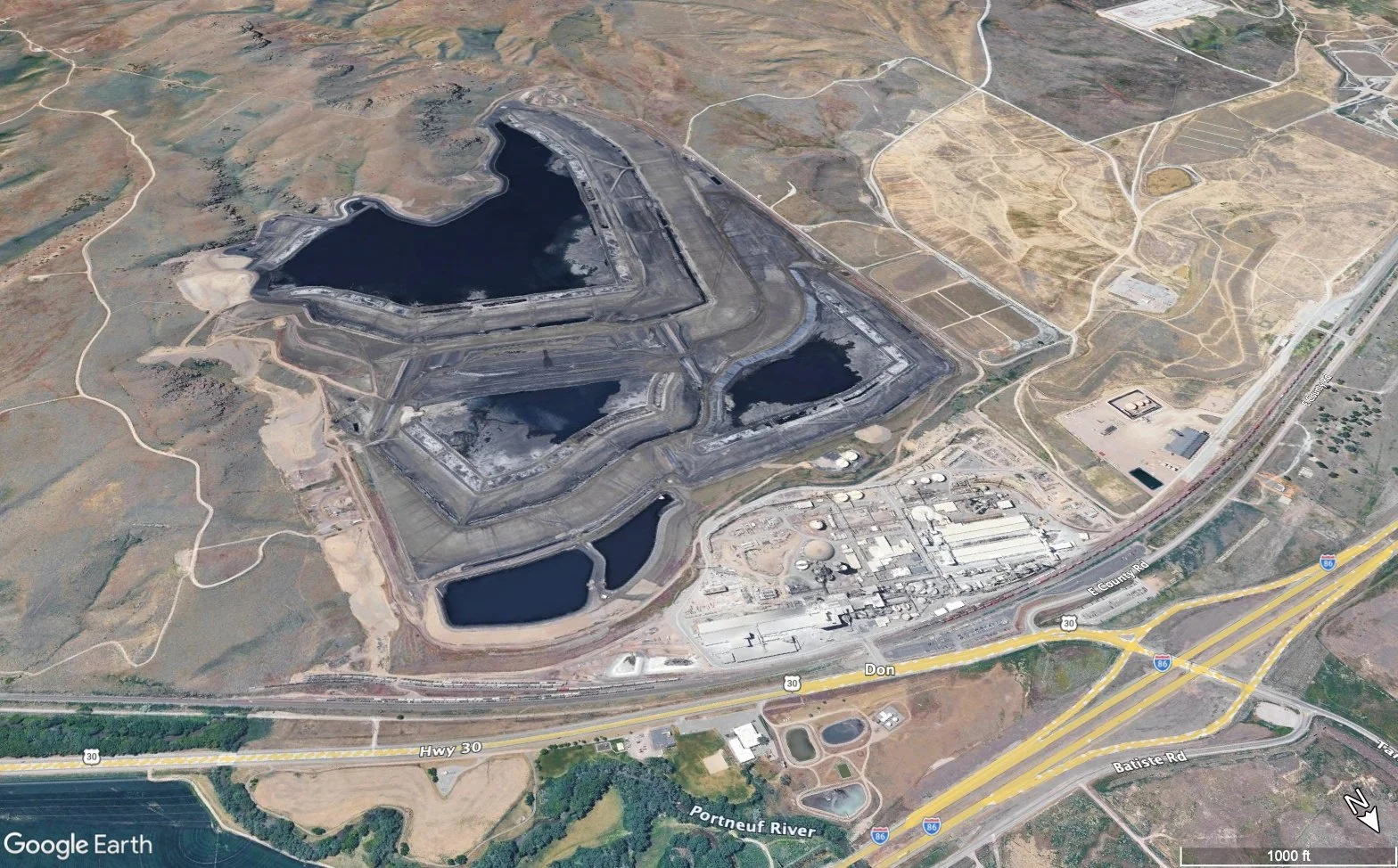
Google Earth photo.
The environmental concerns surrounding the facility are not new. In 2023, Simplot reached a $150 million settlement with the U.S. Environmental Protection Agency and Department of Justice following allegations of improper hazardous waste management associated with its Don Plant operations. Under the agreement, Simplot must stabilize the gyp stack, implement processing modifications to recover and reuse phosphate, and secure $108 million in dedicated financing for a 50-year environmental closure plan.
Despite this history, Simplot has spent more than a decade pursuing additional public land adjacent to the facility to accommodate its future expansion.
An illegal land exchange
Simplot's proposal, known as the Blackrock Land Exchange, would transfer more than 700 acres of public land to the company. The Bureau of Land Management approved the exchange in 2020 despite widespread concerns from the Tribes and the environmental community.
The Shoshone-Bannock Tribes challenged the decision in federal court and ultimately prevailed, with a federal district court invalidating the land exchange in 2023. A federal appeals court upheld that outcome in 2024, and in August 2025, a full panel of the Ninth Circuit Court of Appeals rejected the case again. Each ruling found that the land exchange violated the federal government's trust responsibility to protect the Tribes' interests in lands ceded under an 1898 treaty agreement.
Rather than accept those rulings, Simplot and the State of Idaho are now seeking U.S. Supreme Court review.
But Simplot isn't just waiting for that process to play out; it’s actively attempting to sidestep the court system by going through Congress.
A backdoor attempt buried in a defense bill
With help from Senator Risch, Simplot has inserted a single-sentence provision into a 1,551-page national defense authorization bill. The provision, Section 1091(b), would effectively ratify the original Blackrock Land Exchange and override the legal decisions that invalidated it.
Here's the exact language:
Notwithstanding any other provision of law, the actions of the Secretary of the Interior in the approval and issuance of land patent No. 11-2021-0002 pursuant to the Federal Land Policy and Management Act of 1976 (43 U.S.C. 1701 et seq.) are reaffirmed and ratified.
That seemingly obscure reference to "land patent No. 11-2021-0002" is the key (it refers to the Blackrock Land Exchange).
In other words, Congress is being asked to approve a land exchange that federal courts have repeatedly found unlawful. And rather than debate the proposal through a standalone bill with public hearings and an opportunity for meaningful Tribal consultation, this provision was tucked into an enormous piece of “must-pass” defense legislation.
The implications go well beyond a questionable land deal. The provision would effectively bypass the judicial process and disregard the Shoshone-Bannock Tribes' treaty rights.
An affront to Tribal treaty rights
For the Shoshone-Bannock Tribes, these lands are not simply acreage on a map. They are part of their ancestral homeland, where Tribal members continue to hunt, fish, and gather.
In a recent statement opposing the provision, the Tribes explained:
These lands are part of our homeland. Our people still hunt, fish and gather here, as we have since long before Idaho became a state. Our connection to this land has never broken.
The Tribes also emphasized that their treaty rights survived the 1898 agreement that reduced the boundaries of the Fort Hall Reservation:
Our Treaty Rights are not simply a historical footnote. They are not an inconvenience to be bypassed when a company wants public land. They are promises between sovereign nations, ratified and written into law.
These are important words. Tribal treaty rights are legally binding obligations of the United States government, not optional considerations that can be set aside when they become inconvenient for a private company.
The Shoshone-Bannock Tribes have challenged this land exchange through the proper legal channels and prevailed repeatedly. Now, Congress is being asked to undo those victories through a secretive provision that received no public debate.
What's at stake for Idaho?
While the proposed land exchange has particularly significant consequences for the Shoshone-Bannock Tribes, the implications extend to all Idahoans who care about public lands, clean water, and government accountability.
The Don Plant gyp stack is already a significant environmental liability. Allowing its expansion would raise additional concerns about the long-term management of the hazardous waste stored on site.
Just as importantly, this sets a troubling precedent. If Congress can use a provision buried in an unrelated piece of legislation to overturn court decisions and transfer treaty-protected public lands to a private corporation, what protections do other Tribal nations and public lands have?
Public lands and Tribal treaty rights should not be bargaining chips in corporate land deals.
We urge Idahoans to contact Senator Risch and the rest of Idaho's congressional delegation and ask them to remove Section 1091(b) from the national defense authorization bill, protect Tribal treaty rights, uphold the federal government's legal obligations, and keep public lands out of the hands of a corporation seeking to expand its toxic waste dump.
Senator - DC office - Idaho office
Jim Risch, (202) 224-2752 , (208) 342-7985
Mike Crapo, (202) 224-6142, (208) 334-1776
Representative - DC office - Idaho office
Russ Fulcher, (202) 225-6611, (208) 888-3188
Mike Simpson, (202) 225-5531, (208) 334-1953