
Washington State Transportation Study Paves the Way for Barge Replacement on the Lower Snake River
The latest findings from a Washington State Department of Transportation Study begin to outline how the Northwest could replace the services currently provided by the Lower Snake River dams. The four federal dams, located in eastern Washington, were built for navigation purposes to transport wheat and other commodities to major export facilities at the mouth of the Columbia River. The study provides a variety of alternatives to barging, including a scenario (Scenario 7) that would reduce the number of truck miles traveled to move wheat. This October, people living in eastern Washington will also have opportunities to learn more about the study and provide feedback at in-person open houses.
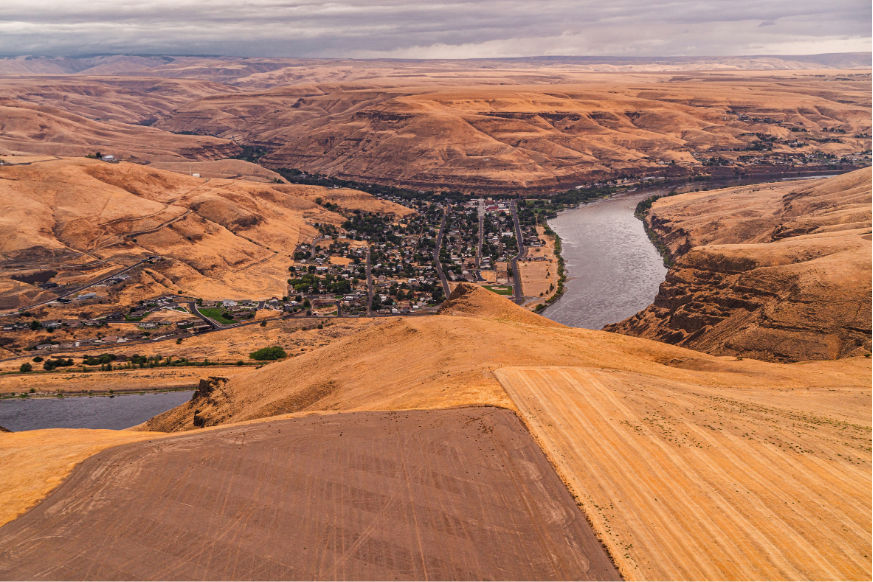
EcoFlight photo.
Scenario 7
This scenario outlines how to shift wheat and other freight currently shipped by barge to be shipped by rail. Rail is not new to the region; two-thirds of the wheat transported to the major export terminals of the Snake River already arrives via rail. Most of the wheat currently transported by barge on the Lower Snake River originates from farms near the Snake River in Southeast Washington, as well as the Idaho Palouse and Northeast Oregon.
How Scenario 7 works:
Reduce the total miles that farm trucks would travel to move wheat to rail terminals, or, for farms closer to the Columbia River, to river ports.
Expand and improve rail infrastructure, including short-line rail service and additional rail terminals.
Add or improve rail facilities at Lewiston, Central Ferry, Lyons Ferry, Dayton, and Kahlotus.
Improve rail lines and build new track on former railbeds that have been preserved for transportation use.
Continue barge transportation on the mainstem Columbia River, with increased use of ports near Wallula and Pasco.
The study also identifies opportunities to expand rail service in Lewiston, Idaho, by adding loading capacity using existing rail infrastructure. Investments in rail infrastructure, terminals, and grain loading facilities will expand the existing rail network and will allow the region to maintain a strong wheat economy while reducing truck travel.
Fewer truck miles would mean:
Improved road safety
Reduced diesel emissions, and
Less tire-particle pollution (6PPD-quinone) entering waterways.
How will this impact farmers?
The infrastructure improvements required to replace Snake River barging will not come without costs. The study estimates that transportation costs for farmers could increase by approximately $8 million to $54 million per year, depending on the scenario and assumptions used. This does not factor in the cost of maintaining the status quo, such as subsidies currently provided for barging. However, affected farmers should be fairly compensated during a transition in transportation services.
The WSDOT study is limited in scope to Washington State; however, it’s understood that farmers upstream of Lewiston will continue to drive grain trucks to Lewiston.
For decades, dam proponents and industry leaders have claimed lower Snake River dam removal would lead to more trucks on the road and higher emissions. Now, we know another option exists.
Live near eastern Washington and want to learn more? Attend the upcoming WSDOT Open Houses in person:
A final study by the Washington State Department of Transportation (WSDOT) into transportation alternatives to barging on the lower Snake River is due to the State Legislature by December 10, 2026. This October, the public has an opportunity to learn about the study and provide input at three in-person Open Houses.
Tuesday, October 6 | 5–7 p.m.
Whitman County Library
102 South Main Street, Colfax
Wednesday, October 7 | 5–7 p.m.
Clarkston High School Library
401 Chestnut Street, Clarkston
Thursday, October 8 | 5–7 p.m.
Mid-Columbia Libraries Pasco Branch
1320 West Hopkins Street, Pasco