
Triumph Mine Update: Remediation Efforts Headed in a Positive Direction
Editor’s Note: This blog was originally published on November 10, 2025, and has not been updated since.
If you’ve been following ICL’s mining work for the last several years, you are probably aware that the Triumph Mine site near Sun Valley has been an ongoing environmental liability. The former lead/zinc/silver mine, which was operational from the late 1800s until the 1950s, has been the State of Idaho’s responsibility to clean up after the mining company ASARCO went bankrupt in 2009. ICL sued the State in 2018 alleging violations of the Clean Water Act due to illegal, unpermitted discharge of mine-polluted water into the East Fork of the Big Wood River. That lawsuit resulted in a legal settlement that required the Idaho Department of Environmental Quality (DEQ) to either 1) obtain a Clean Water Act discharge permit, or 2) eliminate the need for a permit entirely through the use of an infiltration system that diverts all of the mine water so that it does not enter the river. Since then, the State has spent millions of taxpayer dollars to clean up the mess left behind by past mining.
A turning point for Triumph?
However, there is some good news! Thanks to ICL’s tireless advocacy on this issue and the dedicated work of DEQ and the Idaho Department of Lands to remediate the site, it appears that we might finally be rounding a corner when it comes to the Triumph cleanup efforts.
Because building an actual wastewater treatment plant at Triumph is likely infeasible due to cost limitations, community pushback, and impact to the character of this rural location, DEQ decided to proceed with option #2 under the legal settlement: divert the mine water discharge such that it no longer flows into the river. DEQ commissioned a groundwater modeling report in 2024 to assess the viability of using something known as an infiltration gallery to address the Triumph mine water. An infiltration gallery is a type of passive treatment, where polluted water is diverted into gravel-lined artificial ponds. As the polluted water seeps into the ground through these gravels and the underlying soils, ideally the heavy metals are naturally filtered out and diluted such that groundwater concentrations downgradient of the infiltration meet the applicable water quality standards. The DEQ modeling report concluded that the infiltration ponds would lead to reduced metals concentrations in the mine water and would not lead to direct or indirect discharge of pollutants to the river.
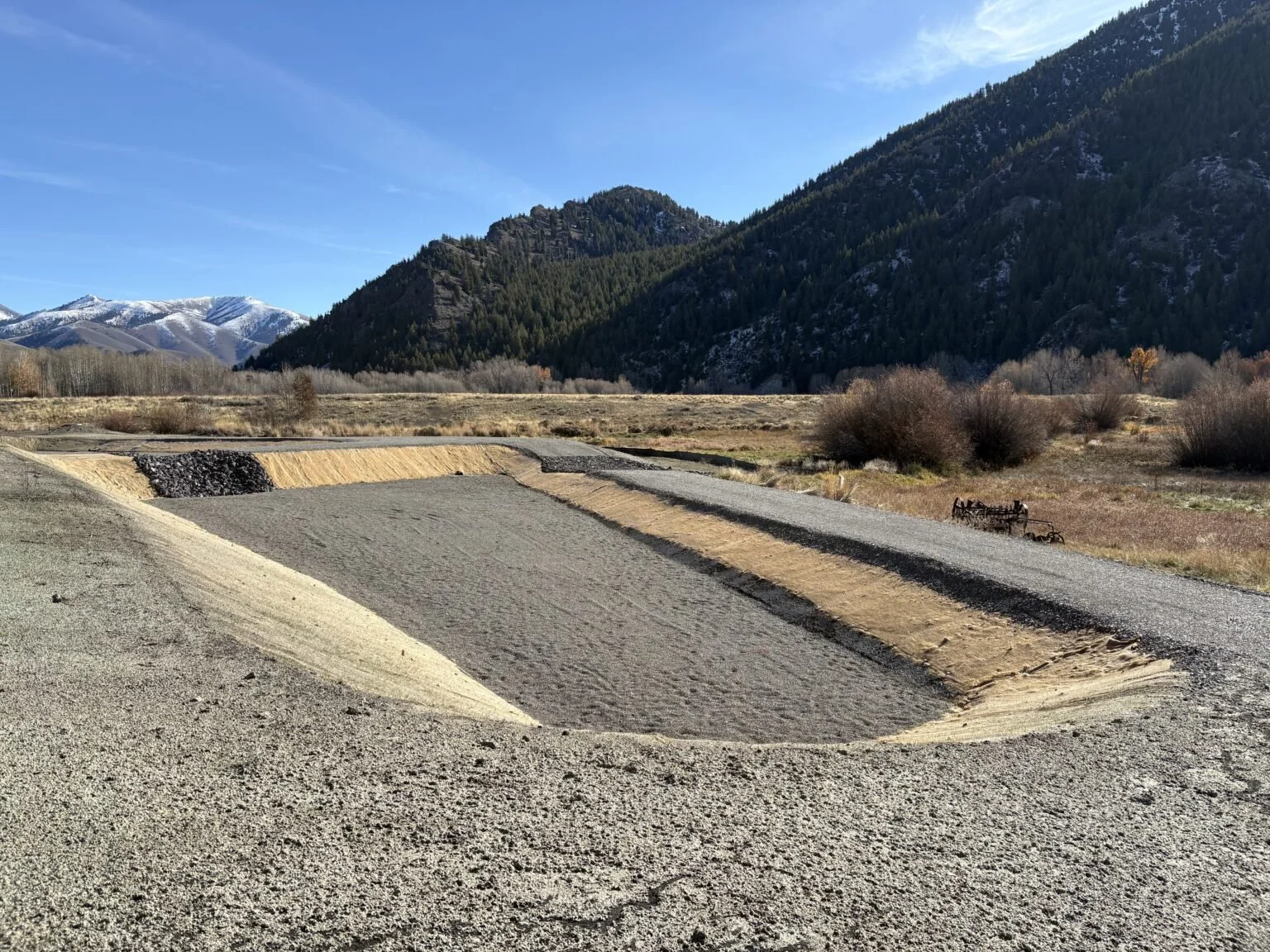
One of the two new infiltration ponds constructed to passively treat Triumph mine water.
These infiltration ponds were constructed in summer/fall 2025 and are actively being used to passively treat mine water. In the new discharge configuration, arsenic-laden water from the historical mine tunnel and associated holding pond now discharge to these new infiltration ponds near the county road rather than being discharged into the wetlands directly adjacent to the East Fork Big Wood River.
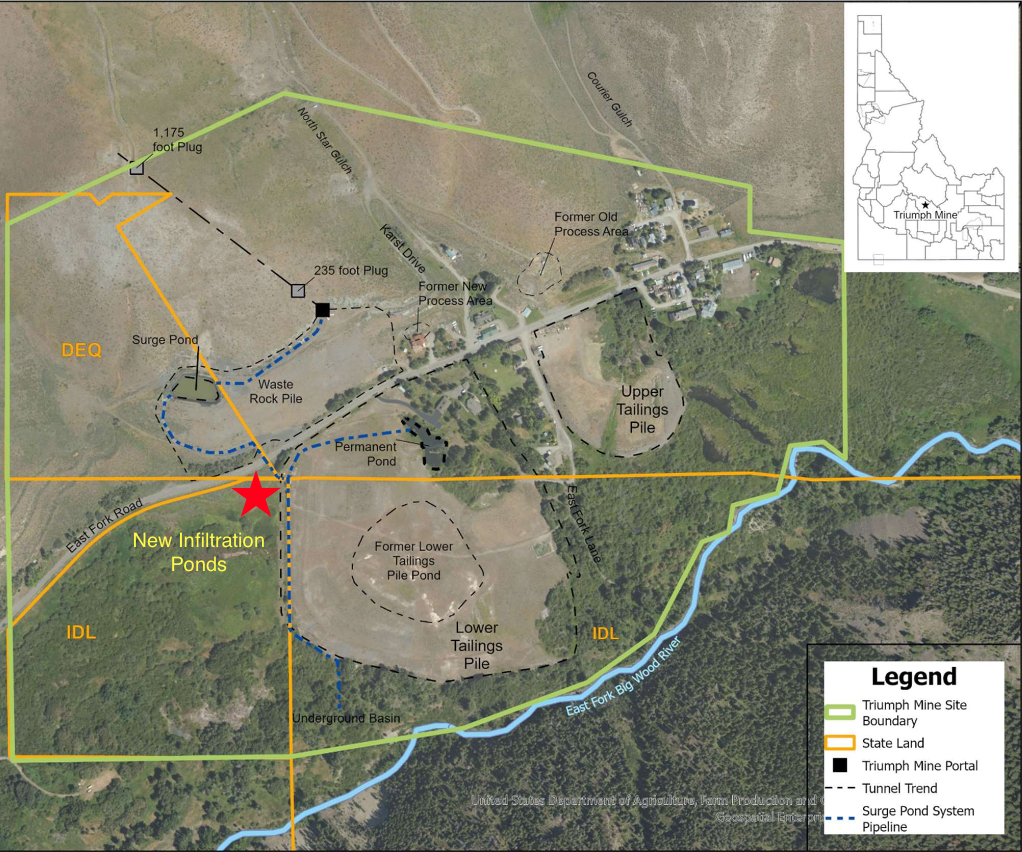
Map of Triumph Mine site adapted from IDEQ’s Fifth Five Year Review Report for Triumph to show the location of the new infiltration ponds.
Potential pitfalls
Although this new infiltration gallery approach is almost certainly an improvement from an environmental standpoint compared to the prior discharge of mine water to wetlands adjacent to the river, we will have to wait and see to know just how effective this passive treatment approach really is. The primary concern with this approach is that it could just be moving the water contamination problem somewhere else without actually solving the underlying issue. ICL will be carefully examining the groundwater quality data collected by DEQ from the wells located downgradient from the new infiltration ponds to ensure that groundwater quality standards are not being violated and that groundwater and surface water in the East Fork drainage is not being contaminated. The infiltration ponds will also require ongoing maintenance in order to remain effective over the long term.
What’s next for Triumph?
While the mine-impacted water coming out of the historic tunnel is one of the biggest problems at the site, it is not the only issue. The large tailings pile at the site remains a source of potential contamination, especially in high runoff years where snowmelt and a high groundwater table can interact with the tailings pile and dissolve heavy metals out of the rock and into the water (like what happened in May 2023). DEQ recently made improvements to the drainage ditches adjacent to the tailings pile to try to minimize this contaminant pathway but there is further work to be done. ICL will continue to work with the State to ensure that Triumph is cleaned up as best as can reasonably be expected.
It’s been a long road to fix up the site, but maybe, just maybe, we are getting there.
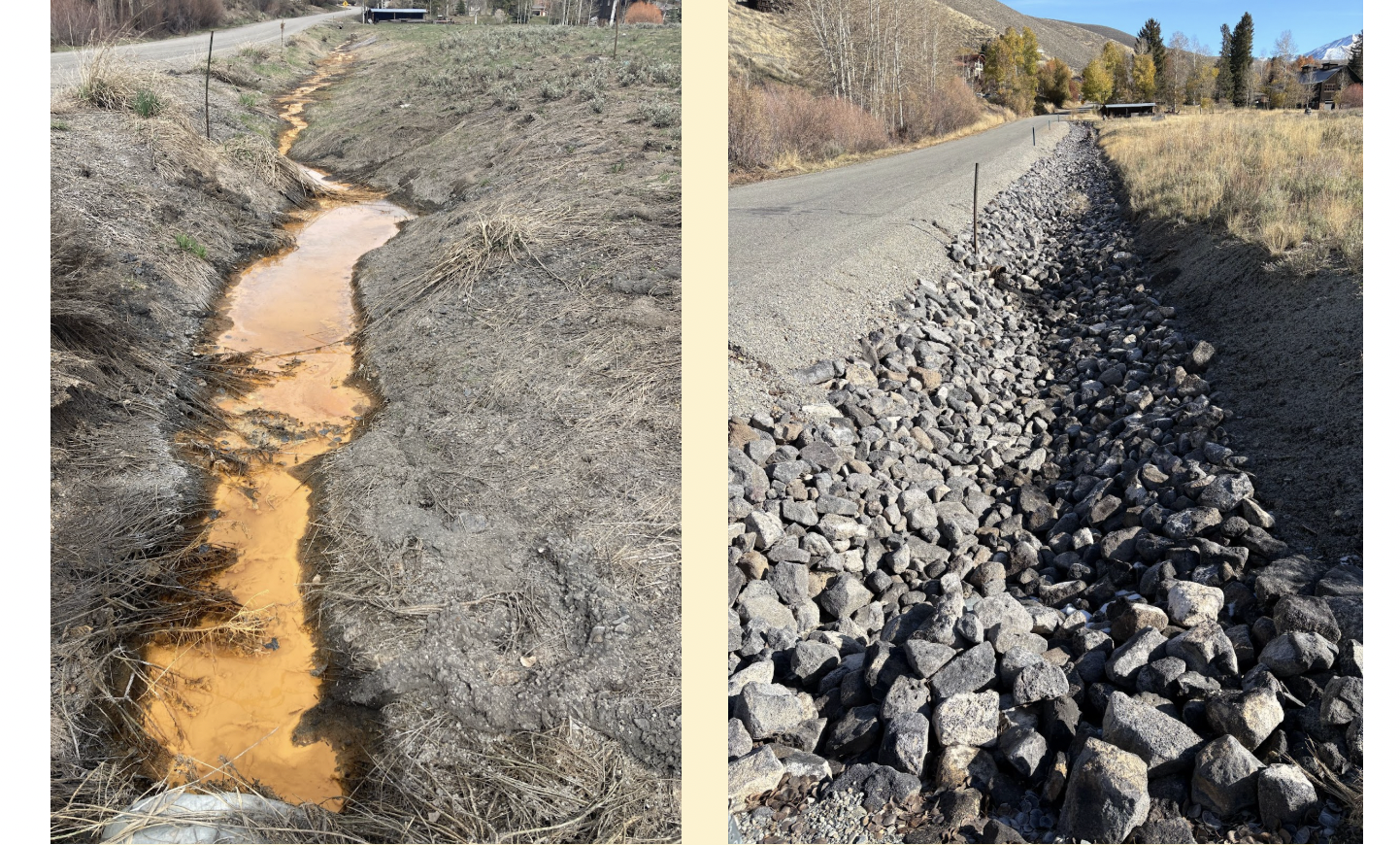
Before and after photo showing a drainage ditch adjacent to the lower trailings pile at Triumph in May 2023 and November 2025 (after remediation work has been completed).