
The Upper Bigwood Project: Here’s What You Need to Know
What is the project?
The Upper Bigwood Vegetation Management Project is a proposal put forth by the Sawtooth National Forest that aims to “improve forest health, reduce hazardous fuels, and restore historical forest conditions and ecosystem diversity in the upper Big Wood River drainage” (per the Proposed Action). The project will involve a mix of vegetation treatments, including commercial logging and non-commercial thinning, to achieve these goals across ~2,500 acres stretching along Highway 75 north of Ketchum between Baker Creek and Galena within the Sawtooth National Recreation Area (SNRA).
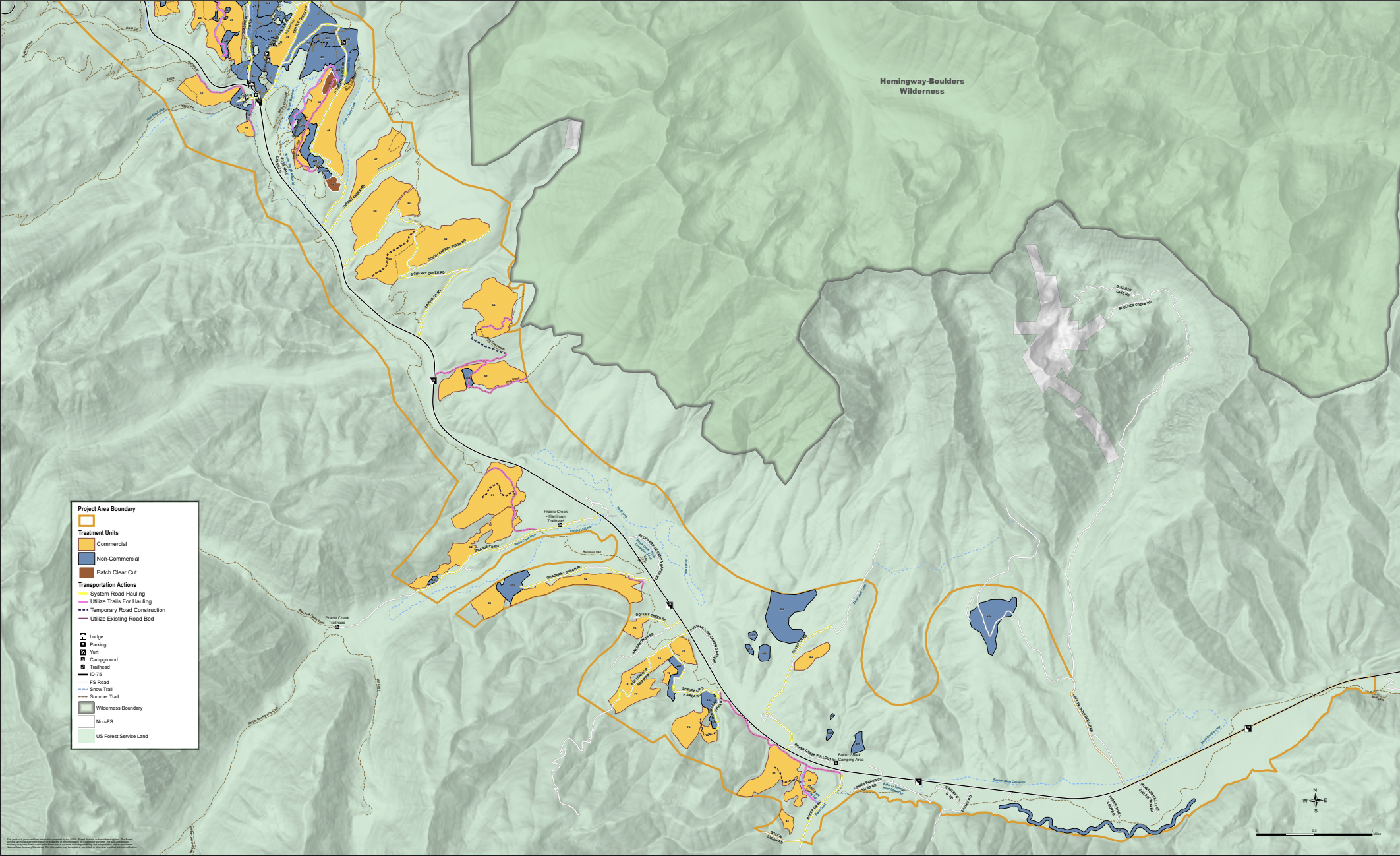
USFS. To view full PDF map, head here: https://usfs-public.app.box.com/v/PinyonPublic/file/2226226052570
This project is proposed to be authorized under a type of Categorical Exclusion (or CE), the lowest level of environmental analysis the Forest Service can advance certain types of projects under. Under recent changes to the National Environmental Policy Act, the Forest Service is not required to hold a formal public comment period for CE-level projects (though they have the discretion to still offer one).
You can find all of the project documents here. And here is a recorded presentation by the Forest Service providing an overview of the project.
Why might we need a project like this?
ICL’s perspective is that we need some version of a project like Upper Bigwood to address wildfire risk and forest health issues. This area of the Sawtooth National Forest has well documented insect infestations and disease spread that will likely continue to kill off large swaths of the forest if not addressed. And while a vegetation thinning project won’t stop a catastrophic wildfire in its tracks, a targeted project focused on protecting values at risk (e.g. Galena Lodge, Highway 75, summer cabins) would likely moderate fire intensity in the event of a wildfire, giving firefighters a better chance to protect those values as well as a better chance for the forested ecosystem to recover post-fire.
What could be improved?
The public process. Given that this project involves commercial logging in one of the most well-utilized and well-loved locations on the SNRA, the public deserves to have a strong voice on this project. Unfortunately, that has not been the case thus far. With no formal public comment period for the project and just one open house late in the project development process. Moreover, the CE being used for the project requires that it “be developed or refined through a collaborative process that includes multiple interested persons representing diverse interests.” While the Forest Service has made presentations to multiple collaborative groups about the project, it would be a big stretch to say they have meaningfully collaborated with stakeholders on the development of the project.
Project design. The current configuration of proposed treatment units and haul routes could be refined and improved upon. For example, some iterations of the proposal have included the use of routes that were previously closed and naturalized as part of the Big Wood Travel Plan using funds from the Blaine County Land, Water, and Wildlife Program (which we don’t want to see). The project could also be tweaked to minimize impacts to wildlife, scenery, and recreation.
Benefits to wildlife. One of the stated objectives of this project is to benefit wildlife habitat, but it is not clear from the Proposed Action which species in particular this project is intended to benefit. The Forest Service should provide additional detail regarding which wildlife species this project will benefit and how exactly it will benefit them.
What’s next?
The Forest Service has previously indicated that they are planning to sign a decision on this project by this July and begin implementing the work next summer. ICL will be asking the Forest Service to take a pause on this project to allow time for more public engagement and for the proposal to be refined through a multi-stakeholder collaborative process.
Here are ICL's detailed comments on this project for reference.
Although there is no formal public comment period for this project, if you would like to provide input on the project, we would encourage you to email your thoughts directly to relevant Forest Service staff:
Nelson Mills - Timber Program Manager/Project Lead (nelson.mills@usda.gov)
Michael Fuller - SNRA Area Ranger/Deciding Official (michael.fuller2@usda.gov)
Casey Johnson - Sawtooth Forest Supervisor (casey.johnson@usda.gov)