
Climbing Against the Current: Idaho’s Pacific Lamprey
Idaho is losing a fish that you may not have even heard of, and it has been swimming in Idaho’s waters for over 400 million years.
While they may be less well known than salmon, Pacific Lamprey have been part of the Columbia and Snake River Basins for hundreds of millions of years, long before Idaho looked the way it does today. In Idaho, they were once common, migrating inland alongside salmon. Historically, lamprey travelled far up the Snake River basin, even reaching tributaries near Boise. Today, their presence has been reduced to a small fraction of their historical range, and without intervention, they could disappear from Idaho entirely.
Pacific lamprey are anadromous, meaning that after they are born in freshwater, they migrate to the ocean, and they return inland to spawn. As juveniles, lamprey spend years as larvae living within river sediment, filtering nutrients from the water before beginning their migration to the ocean. Like sockeye, when lamprey return to Idaho as adults, they make the whole journey without eating, relying entirely on their stored energy reserves to reach their freshwater spawning grounds and complete their life cycle.
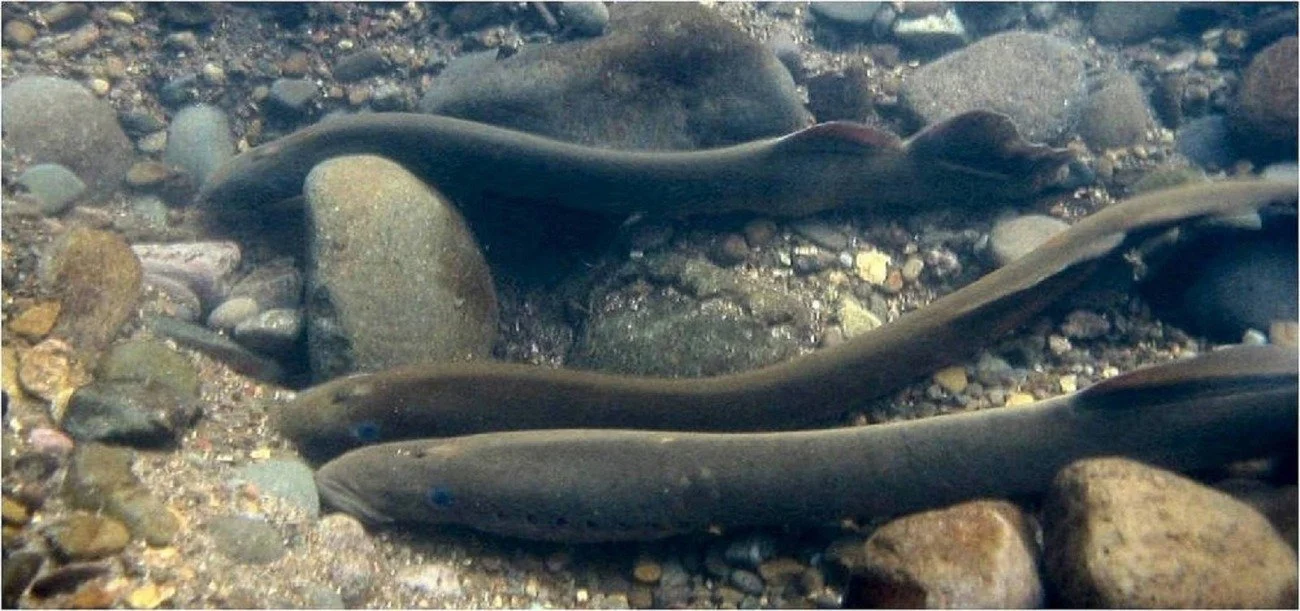
USFS photo.
Lamprey also have a much different look than other fish in Idaho’s rivers. Lamprey have long, eel-like bodies, smooth scaleless skin, and a round suction-cup mouth lined with small teeth, rather than a jaw. This unique design allows them to attach to surfaces and climb, helping them navigate the cold, fast-moving and free-flowing rivers that they evolved in. Using their suction-cup mouth, they have the ability to climb rocks and even waterfalls.
While they are often overlooked and underappreciated, Pacific lamprey play an important role in the region’s ecosystems. Like salmon, lamprey serve as a nutrient pump, bringing nutrients from the ocean back to Idaho’s freshwater. They also serve as a food source for birds, mammals, and fish, helping to distribute predation pressure across the food web. In systems where lamprey are present, they add balance and resilience.
Their importance also extends beyond ecology. For many Tribal Nations in the Columbia River Basin, including the Nez Perce Tribe, Pacific lamprey are the First Food with deep cultural, nutritional, and spiritual significance. Their harvest is tied to long-standing traditions and relationships with the river.
Despite their significance, Pacific lamprey populations have experienced dramatic declines across the basin. In Idaho, their upstream migration has become nearly impossible. The four lower Snake River dams have created a series of barriers that are extremely difficult for lamprey to navigate. While their suction-cup mouths allow them to climb over natural features, dams present vastly different challenges that they have not evolved to pass. Fish ladders, primarily designed for salmon, rely on strong, continuous flows and smooth surfaces that do not provide the attachments or resting points that lamprey need. Even when they are able to enter the ladders, many struggle to make progress through them, leading to exhaustion. Reservoirs behind dams add another challenge, as they slow the river, increase water temperature, and reduce the habitat quality. These challenges all compound with each dam and reservoirs that they encounter on their way home to Idaho. At Lower Granite Dam, returns have fallen to just double digits (CRITFC).
In response, Tribal Nations and regional partners have led efforts to prevent further decline. These efforts include moving lamprey around dams and upstream, improving passage conditions, and better accounting for lamprey in fisheries and river management. These efforts are critical to prevent extinction, however, they also highlight the scale of the challenge. Pacific lamprey rely on connected, flowing, and functioning rivers, and when rivers are transformed into a series of reservoirs, recovery becomes difficult to achieve at the scale needed.
The decline of Pacific lamprey in Idaho reflects broader challenges within the Columbia and Snake River systems. As a species that needs clean water, intact habitat, and uninterrupted migration, their status is a reflection of the broader health of the river system itself. These species have persisted for hundreds of millions of years, and whether or not they remain part of Idaho’s rivers will depend on how our rivers are managed moving forward.
