
What have 35 years of listing under the Endangered Species Act (ESA) meant for Idaho’s beloved sockeye salmon? Well, this year only 8 naturally-spawning sockeye swam back to Idaho’s Stanley Basin.
Idaho’s sockeye salmon are remarkable. Born in the central Idaho mountains, these fish migrate over 900 miles to the Pacific Ocean. Years later, they swim the same stretch, climbing more than 6,500 feet of elevation back to their natal homeland. It's the longest and highest migrations of any sockeye population in the world, and the southernmost population of the species. The Stanley Basin provides some of the highest quality habitat in the lower 48 for these fish to spawn before the end of their lifecycle. Prior to decades of overfishing, irrigation diversions, pollution, and the construction of dams on our rivers, an estimated 25,000 sockeye salmon returned to reproduce along the shorelines and inlets of the Stanley Basin lakes in the upper Salmon River drainage.
From 1985 to 1990, only 58 wild sockeye returned to Idaho. In 1991, the Shoshone-Bannock Tribes successfully petitioned the U.S. government to list Snake River sockeye under the ESA. In 1992, only one male sockeye salmon, dubbed “Lonesome Larry,” returned. Within just a few years, 12 populations of salmon and steelhead across the Columbia River Basin were also listed under the ESA. Tribes across the Northwest, who have protected salmon populations since time immemorial, were instrumental in submitting many of these listing petitions and have advocated for urgent, drastic action to save them from extinction. Without ESA status, federal protections and investments in salmon recovery almost certainly would not have happened. And without the leadership of Northwest Tribes, Idaho's salmon would have had far fewer advocates fighting for their survival. Their work helped bring these fish back from the brink of extinction and allowed future generations of Idahoans to see wild salmon return to their home waters.

Sockeye salmon. USFWS/Ryan Hagerty photo.
Over the past 35 years of ESA protections and investments, Idaho isn't even close to meeting the minimum recovery criteria for sockeye salmon. And meeting those criteria would still leave us a long way from the healthy, abundant populations that once returned to the Stanley Basin.
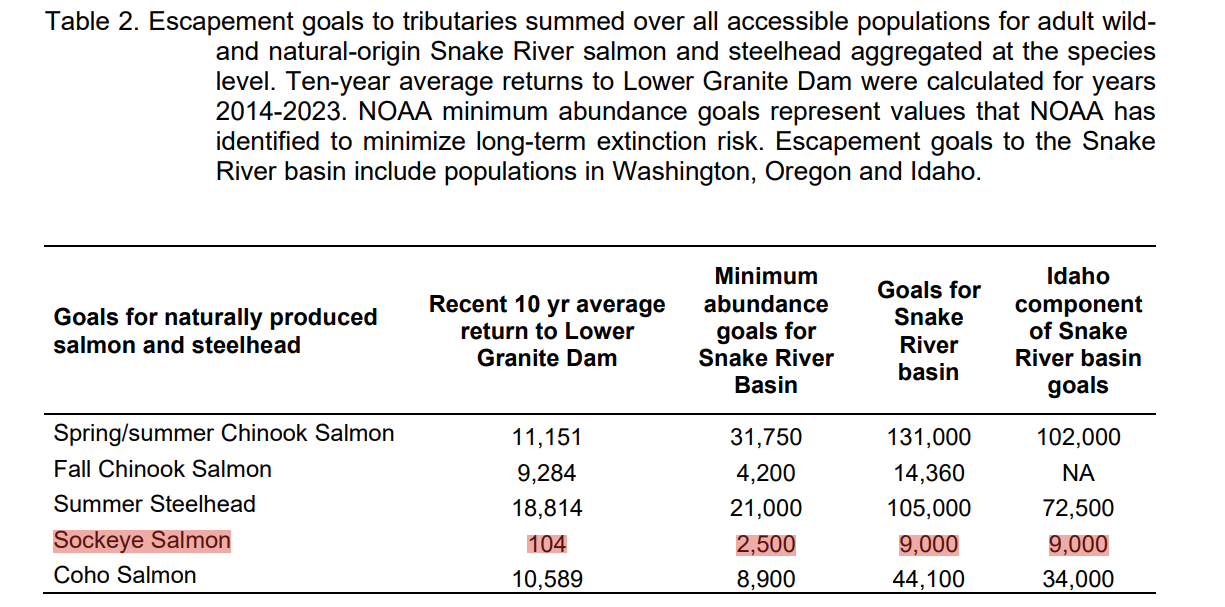
This year, only 8 Sockeye successfully swam back to Redfish Lake. Another 841 Sockeye were trapped downstream at Bonneville and Lower Granite dams and hauled via truck. According to NOAA’s Recovery Plan for Snake River Sockeye Salmon, the natural-origin population abundance level required to meet the delisting criterion is 2,500 sockeye adults, of which 1,000 must be in Redfish Lake, 1,000 in Alturas Lake, and 500 in Pettit Lake.
But, delisting is not the same as recovery. For a moment, let's imagine that we live in a world where Idaho elected officials not only want Sockeye removed from the ESA, but actually want to recover abundant populations for future generations. The Columbia Basin Partnership, a diverse group of stakeholders including Columbia Basin tribes; fishing, agriculture, conservation, river transportation, port, and hydropower interests; and the states of Idaho, Montana, Washington, and Oregon, concluded that the recovery goal for healthy and abundant sockeye salmon populations is 9,000 wild sockeye returning to the Stanley Basin.
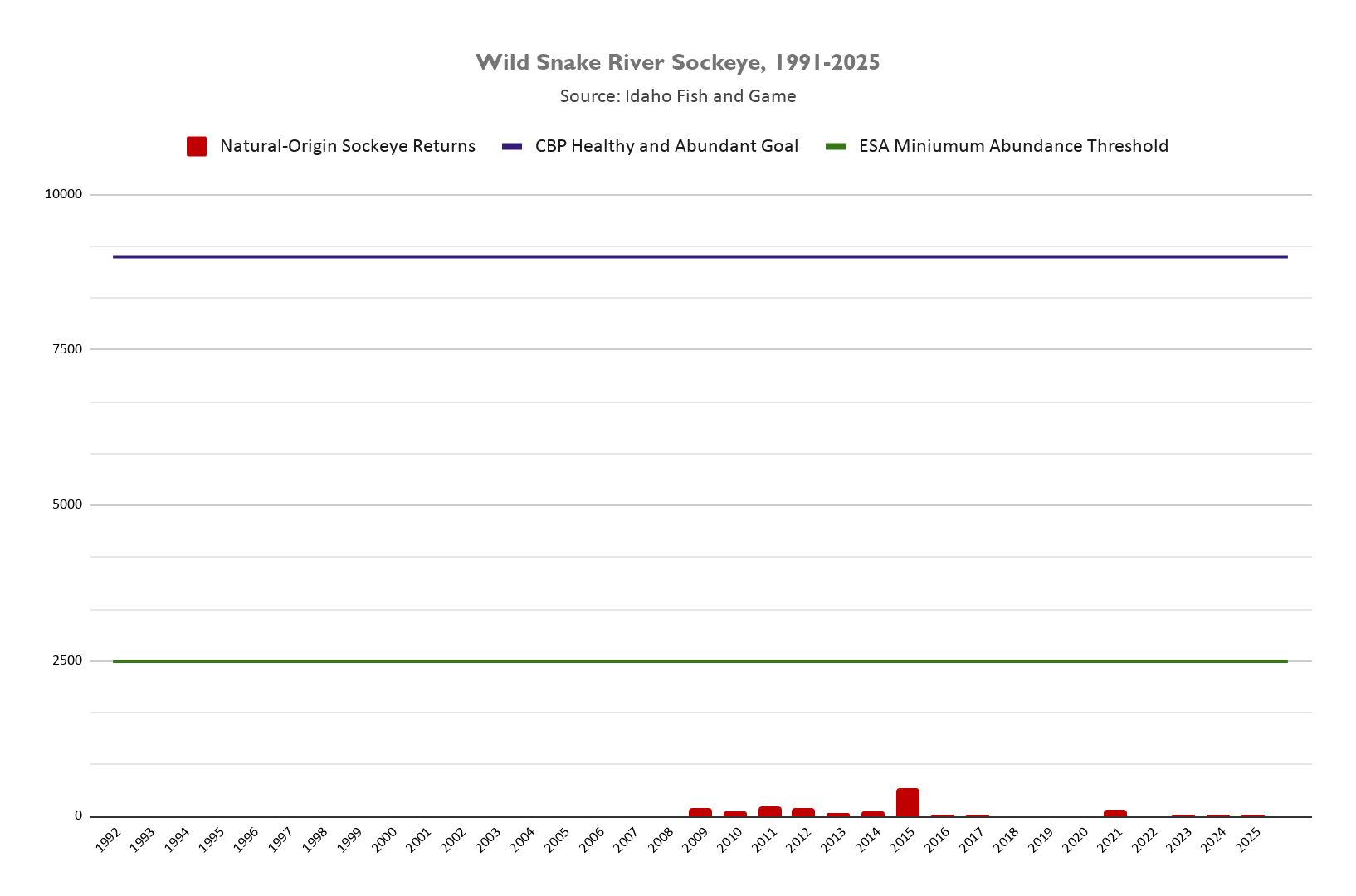
Sockeye downstream of the Sawtooth Basin are struggling, too. As shown below, the 10-year average for natural-origin Snake River sockeye that reached the Lower Granite Dam (the 8th dam sockeye must pass on their journey home) from 2014 to 2023 was just 104 fish, nowhere near the minimum abundance goal of 2,500 fish. Even fewer fish managed to return farther upstream to the Sawtooth Basin each year.
What about hatchery fish?
Hatchery programs and trap-and-haul operations have played an important role in preventing Snake River sockeye from going extinct. But getting fish into the Stanley Basin is not the same as recovering naturally reproducing populations. Long-term recovery depends on maintaining the genetic diversity and wild characteristics that allow sockeye to survive and reproduce in their native habitat.
Idaho Fish and Game has recognized the importance of maintaining the genetic integrity and diversity of wild fish stocks. While hatcheries and transportation can help sustain populations in the short term, they cannot replace the need to restore the conditions that allow wild sockeye to thrive on their own.
Where do we go from here?
We’ve restricted commercial and recreational fishing. We've spent tens of billions of dollars on salmon recovery throughout the Snake and Columbia River Basins. We've built hatcheries, trucked fish around dams, killed predators, and released cold water from upstream reservoirs to improve downstream conditions. These efforts have helped prevent extinction, but they haven't brought Idaho's wild salmon anywhere close to recovery.
And yet, after 35 years, we have to acknowledge that something fundamental is missing from our recovery strategy: removing the dams that kill thousands of baby salmon every year. The 2022 NOAA Rebuilding Report described Lower Snake River dam removal as the centerpiece action for recovering salmon populations.
We cannot expect to recover abundant Idaho salmon populations without removing the four lower Snake River dams.
As we look back at the last 35 years, it is clear that Idaho’s congressional delegation has failed when it comes to salmon recovery. There have been efforts to change course. Rep. Simpson supported lower Snake River restoration, but lacked support from the rest of Idaho’s congressional delegation. Idaho’s Senators, both of whom are old enough to remember what a free-flowing Lower Snake River looked like, have not advanced salmon recovery. In fact, Sen. Risch introduced a bill that would lock in deadly dam operations which have been overturned by a federal court, and Rep. Fulcher cosigned legislation that would ban even the study of dam removal.
Idaho needs leadership that’s committed to investing in our future, not hitching us to outdated infrastructure. We can replace and maintain the services of the Lower Snake River dams while preventing Idaho’s iconic fish from going extinct. We can invest in truck-to-rail infrastructure that replaces the truck-to-barge system on the Lower Snake and work with Congress to protect farm profitability. The 700 megawatts that the dams produce annually is easy to replace.
Dams alone did not cause the devastation of wild salmon populations, but our elected leaders' decisions to keep outdated dams could be what drives Idaho's salmon to extinction. Idaho’s elected officials must be held accountable for failing to recover our beloved sockeye salmon or we will lose them forever.
In five years, when we reach the 40th anniversary of their ESA listing, what will we be writing? Will it be another story about historically low returns and another generation of failed recovery efforts? Will we be writing about the extinction of Idaho's wild sockeye salmon? Or will we finally be able to celebrate the return of healthy, abundant wild salmon populations to Idaho's rivers and lakes?
ACT NOW: Take action here to sign an open letter created by the Youth Salmon Protectors, which will be hand-delivered to our decision-makers in Washington, D.C. this coming spring.